Tuesday, June 5, 2012

The Blasphemer

Shortlisted in 2010 for the UK Costa Novel Award, over the last fortnight I have read The Blasphemer by Nigel Farndale. This is the first book this year (other than non-fiction books) that I have read that is not for  a challenge. I read this one for pleasure (not that the others weren't pleasant), because my mum recommended it. Thanks mum- it was a great pick!
   It is an intelligent novel, which is described on the cover as 'unforgettable'. For most of the novel, I was wondering what was so unforgettable about it. Certainly, the characters are real, and the issues are engaging, although sometimes it felt like I was being lectured. It's the ending that ties everything together perfectly, and it truly is an unforgettable story!


This novel is about love, cowardice, trust and forgiveness. It follows the lives of Daniel and Andrew Kennedy. Andrew is Daniel's great-grandfather. Daniel is a modern-day father, atheist, greenie, scientist, and metro-sexual.
   I learnt a lot. I learnt that the UK army shot its deserters during WWI (I thought it was only the French who did that). I learnt a bit about physics, music, biology, religion, and the human spirit.
   Read it!

Wednesday, May 30, 2012

The Forgotten Sea

I had high expectations for this book. I read it as part of the Australian Women Writers challenge ... otherwise I wouldn't have finished it. Beverley Harper is Australian, though she spent a significant amount of her life in Africa.
   On the back of this edition, she is said to be Australia's answer to Wilbur Smith. Now, I love Wilbur Smith, and have read a lot of his sagas over the last few years. However, The Forgotten Sea by Beverley Harper is nothing like a Wilbur Smith novel. It's more like a murder mystery in a Mills & Boon novel.


Having said that, I did actually have a lot of guilty pleasure reading this novel. About half way through, when the Mills & Boon style romance got hot, I couldn't put it down. Her fans have posted online that it is one of her best novels.
   It was full of cliches, it's predictable and a bit ridiculous, but the reader does become invested in the characters.
   So if you like a murder mystery, and you like suggestive paragraphs about hot sex (but never actually have the sex described), then you should give this novel a try.

Saturday, May 19, 2012

Lady Chatterley's Lover

As part of my commitment to read more classics, I read Lady Chatterley's Lover by D.H. Lawrence. Having read Sons and Lovers by Lawrence earlier this year, I was really looking forward to the prose and character development that I had enjoyed so much in Sons and Lovers. I had no idea what to expect when I picked this book up, which is usually the case when I read something - I don't do much research before hand. I was a bit shocked, I must admit, but this was one of the best books I have ever read.


After I had finished reading Lady Chatterley's Lover, I did a bit of research. I didn't know the controversy that surrounded the publishing of this novel. I hindsight, though, I can see why some stuffy people got their nickers in a knot over this book.
   Lawrence wrote it in the 1920s, which shows how progressive he was. It was only printed privately in Italy, until it was finally published openly in the UK in the 1960s. Penguin Publishing was prosecuted under the Obscene Publications Act, but the verdict was "not guilty". Australian banned the book, and as recently as 2009, the Australia Post refused to sell the book in its store or outlets!
   This novel is not smut or obscene, despite some of the uses of the "f-work" and the "c-word". There are very descriptive sex scenes, but overall the book is about intimacy. It was extremely progressive for Lawrence to have been writing about the female orgasim or about menopause. It is the character development and emotion in this novel that saves it. You take the journey that Lady Chatterley takes during her affair. The ending is also magnificently done - it leaves you to meet your own expectations of 'happily ever after'.
   As well as the sex, there is a lot of exploration about the decline of the social fabric of society - about what industrialism is turning the working class into, and also about the lowering of the upper class. It is very much about the class system, and Lady Chatterley's battle against it and struggle to accept her position. It touches on the dissatisfaction of the lower and middle classes, the strikes, and has references to socialism and anarchism.
   I think my own self awareness and sexuality has benefitted from reading this book - I think we should all live with awareness in the moment, and appreciation for what we have, rather than just pretending to live.

Friday, May 4, 2012

The Ballad of Les Darcy

As part of the Aussie Author Challenge, this week I read The Ballad of Les Darcy by Peter Fitzsimons. I have now read about four of Peter Fitzsimons' novels, and he has a unique writing style - it is like he is sitting beside you telling you the story. He writes non-fiction, but he makes it like a proper story, rather than just reciting research. I was also lucky enough to hear him speak in Wagga Wagga two years ago, and had him sign a couple of his books.


I had heard nothing of Les Darcy, I am ashamed to say. I was a bit disappointed, because I thought it was going to be the story of a boxer-tured-war hero. In fact, he died when he was twenty-one, just after he had enlisted - he didn't even get to war.
   Even though he died so young, Les Darcy was already the middleweight champion of the world, and the light heavyweight and heavyweight champion of Australia! He is one of Australia's greatest athletes, ever, but he is virtually unknown (to my generation, at least). I am so glad that Peter Fitzsimons wrote this little gem of a novel (only about 50,000 words for the Books Alive initiative for the Australian Government).
   The novel has caught the flavour of the time, in the early 1910's and through the first years of World War I. I cannot believe the amount of pressure that the Australian press and public put Darcy under to join the Army. His mother refused to sign the paperwork, so whilst he was under twenty-one years of age, it wasn't his choice whether he joined up or not. But everyone seemed to ignore that fact.
   His spirit was also very inspiring. He was such a straight-living young man, who came from a family that must have struggled when he was young. There is very little about his early years, which I imagine to be very difficult. There is also very little about his relationship with his drunken father (who, somehow, manages to outlive his younger mother by about 8 years!). I might explore some other books written on Les Darcy, since I am intrigued by the struggling and working classes around the time of Australian federation.

Monday, April 30, 2012

The Hunger Games Trilogy

I started reading the Hunger Games because I wanted to read the book before I saw the movie (which I still haven't seen). I loved the first book so much that I quickly read the next two. They are a great trilogy by Suzanne Collins - very well structured - and suitable for a wide variety of readers. I think they are aimed at young adult readers, but I wonder if the young adult reader will fully understand the mental health problems that Katniss develops.


The Hunger Games is the first novel. I don't want to focus on the plot or what happens, since the story is probably generally known by most already - or you can go to Wikipedia and find the plot. So, I don't know what else to say - except it should be read quickly, like you're scoffing down and indulging in a delicious dessert!


Catching Fire is the second novel. Continuing to read this trilogy was very indulgent - I am meant to be reading classics and literary works that extend my writing. By the ease that I can slip back into reading young adult science fiction is amazing. This adventure with Suzanne Collins has made me think that I should not try to buck what I like most, and perhaps I should be writing young adult science fiction, instead of struggling with historic sagas.


Mockingjay is the final novel of the trilogy. I didn't want to let these characters go! As simply written as it is, the characters are very well developed. Obviously, particularly Katniss, whose turmoil is palpable. I rejoiced, in a way, when Katniss could let go of some of her barriers and find solace in Peeta. I felt that there is hope, after all.

Saturday, April 28, 2012

Tiger Men

I just finished reading Tiger Men by Judy Nunn as part of the Australian Women Writers Challenge. This is the first book by Judy Nunn that I've read, and I did enjoy it. I will be looking out for her other novels. The style reminds me a bit of Bryce Courtney, because it was a long saga without a real plot. It was just about life, and the reader really gets invested in characters.


The tiger referred to in the title is not the typical big cat that is brought to mind. The tiger is the Tasmanian tiger, now extinct. Throughout the novel, Judy Nunn draws snippets from another book written nearly 100 years ago, about the systematic extermination of the Tasmanian tiger. It was heart-wrenching.
    In fact, the whole novel was quite educational. Tasmania lead Australia in many respects, including having electrical street lights installed. The last part of the novel was also a good overview of Australia's participation in World War I.
   The story starts by following three men; Silas Stanford, a wealthy Englishman; Mick O'Callaghan, an Irishman on the run; and Jefferson Powell, an idealistic American political prisoner. It is also the story of the strong, proud women who loved them. Then the story branches out and follows the three families for three or four generations.
   Highly recommended.

Monday, April 23, 2012

The Guide To Writing

I know I have been quiet, and a bit slack with my writing lately. I am busy, but I can make all the excuses in the world. The fact is, I should make time to write.
   I'm certainly making time to read.
   Today, a friend sent me a great link; to Timothy McSweeney's Ultimate Guide to Writing Better Than You Normally Do. It's funny. It's inspired me again.
   Please, help me. All those followers; keep reminding me why I'm doing this. Give me little tips. Ask me why I haven't posted for a while.

Saturday, April 14, 2012

The Happy Prince

Another classic for the 2012 Classics Challenge: The Happy Prince and Other Fairy Tales by Oscar Wilde. This book of little moral tales is charming. I wish it had been read to me as a child, so I am keeping them book to read to my own children (when I have some ...). I was put onto this book by the First Tuesday Book Club.


The Happy Prince is one of the nine fairy tales written by Oscar Wilde. It is the tale of an ornately decorated statue who is saddened by the poverty around him. So he asks his only friend, a late migrating swallow, to take his jewels to those in need.
   When the Happy Prince has given all he has, and is no longer so beautiful, the rich men of the city meet to decide his fate.
   The Happy Prince's selflessness opens up the eyes of his friend, the swallow. The swallow doesn't feel the cold of the winter, because he is warmed by doing good and bringing joy to the needy. The swallow eventually sacrifices his life, by not migrating, and dying from the cold, once his task of dispersing the Happy Prince's riches is done.
   What I found interesting throughout these fairytales, and which I don't really appreciate in a child's book, are some of Wilde's own views put across - such as some very religious references, and also some references to Jews. I found them subtle and confronting.
   All these fairytales are little tales of morality. I really enjoyed them. Great lessons for kids.

Monday, April 9, 2012

There Should Be More Dancing

Another novel towards the Australian Women Writer's Challenge: I read There Should be More Dancing by Rosalie Ham last week. I've read Rosalie's two other novels (Summer At Mount Hope and The Dressmaker) and I enjoyed them far more, I must say. This novel is not as wickedly funny. It took me longer to read, and it was probably more emotionally challenging.


Margery Blandon was always a principled woman who found guidance from the wisdom of desktop calendars. She lived quietly in Gold Street, Brunswick for sixty years until events drove her to the 43rd floor of the Tropic Hotel. As she waits for the crowds in the atrium far below to disperse, she contemplates what went wrong; her best friend kept an astonishing secret and she can't trust the home help. It's possible her first born son has betrayed her, that her second son might have committed a crime, her only daughter is trying to kill her and her dead sister Cecily helped her to this, her final downfall. Even worse, it seems Margery's life-long neighbour and enemy now demented always knew the truth. There Should Be More Dancing is a story of Margery's reckonings on loyalty, guilt and love.
   I didn't like Margery, and I didn't feel much empathy for her. She was a nasty, narrow-minded woman, who purposely closed off her emotions to her family. It's sad that she wasted her life, and realises too late. She's eighty, and what kind of life can she now lead?
   The characters are vivid, unique and have realistic traits. They are three-dimensional characters, and Rosalie Ham is very good at character development. Unfortunately, I think there is a reason why so few novels' central characters are elderly, and that is that they don't generate much action.
   It's a great novel on its own, but Rosalie Ham's other novels are so brilliant that I was disappointed by comparison.

Friday, April 6, 2012

April Prompt - A Classics Challenge

I read Charles Dickens' Great Expectations most recently, as part of the Classics Challenge. I'm ashamed to say that I have never read Charles Dickens before. This month's prompt focuses on the cover of the book.
   The edition that I bought and read had close-up of a pair of iron manacles laying in a swamp. It's a fitting cover, having now read the book. But when I first picked it up, it wasn't an appealing first impression. Originally, I couldn't find an image online of my cover, but this time I found it and I have also included a number of other covers from other editions (there has been so many).


The above covers reflect many aspects of the book. My cover, with the manacles, are obviously the chains that Magwitch filed off in the swamp when Pip was a child. The second cover is of the crazy old Miss Havisham, in her wedding gown and dead flowers. The third is of Magwitch and Pip in the graveyard, where the story begins, with Miss Havisham, Estella and Howard in the background. The fourth is just a painted image of Pip himself.
   My favourite part of the story is Miss Havisham, so I really like the cover with just her on the front.

Thursday, March 29, 2012

The Messenger

I read The Book Thief two years ago, and really thought it was unique and powerful. So when I saw another book by Markus Zusak at the book shop, I snapped it up. Zusak wrote The Messenger before The Book Thief. It won the 2003 CBC Book of the Year Award (Older Readers) and the 2003 NSW Premier's Literary Award (Ethel Turner Prize), as well as receiving a Printz Honour in America.
   The Messenger probably hasn't been as popular as The Book Thief, because it doesn't have as much international appeal. It's topic does not focus on an international traumatic event on WWII. But, I think Zusak's writing is better in The Messenger - I think it's more subtle and possibly even more touching.


Blurb: Ed Kennedy - cab driving prodigy, pathetic card player, useless at sex - shares coffee with his dog and is in nervous-love with Audrey. His life is one of suburban routine and incompetence, until he inadvertently stops a bank robbery.


That's when the first ace turns up and Ed becomes the messenger. 
Chosen to care, he travels through town, helping and hurting, until only one question remains. Where are the messages coming from?


This is a novel "about glowing lights and small things that are big". It's about a Good Samaritan. It's about very normal Aussies. It's about one particularly normal young man who does some loverly things (small things that mean a lot) for other people. It's very spiritual. There are lots of messages: to be selfless in love, about the meaning and value of aspirations, and about the joy we can experience despite the difficulties we face in day-to-day life. It's a novel that can be hard and confronting, but it's a novel that is very funny and real.
   The narrative voice in this novel is so strong - it's a brilliant, real voice. His language is authentic, blunt, and sounds just like he's talking to us. It doesn't have too much flowery, emotional investigation. It just is.
   Please read it!
   P.S. Another novel for the 2012 Aussie Author Challenge.

Saturday, March 24, 2012

Great Expectations

Great Expectations by Charles Dickens is the novel that I alluded to in an earlier post that I was struggling with. I found it slow and boring. The language is lovely, and there is some wicked humour and beautiful phrases. However, if Dickens had written this book in this century, an editor would have made it about half as long as it is.


I think part of the reason that I didn't enjoy it is that I didn't like Pip. Usually, if a book is well written, I can put aside my dislike for the character, but I couldn't with this novel. Pip would make me sigh with frustration at his snobbery. I laughed when Trabb's boy was making fun of Pip for pretending not to know anyone and making out that he was too good for the locals where he grew up. But even with Pip narrating from later in life, I still think he has very little insight. Or very little insight into Biddy, who knew him better than he knew himself.
   Because I cannot generate much enthusiasm for this book, I will answer some of Penguin's bookclub questions:

   Why do you think it is one of Magwitch's principle conditions that Pip (his nickname) "always bear the name of Pip" in order to receive his financial support?
   I don't think there was a deep and meaningful reason for this, like some other reviewers. Magwitch was poorly educated and a criminal. Often, criminals go by an alias. Magwitch didn't know Pip's real/full name, so he had to identify Pip by the name he knew, and he wanted Pip to retain the name so that he could find him.

   Why do you think Miss Havisham manipulates and misleads Pip into thinking she is his secret benefactor? 
   She was a wicked, bitter old lady and wanted to inflict emotional turmoil on Pip. By letting him think that she was his benefactor, she kept him tied to her and Estella, whilst he might otherwise have gone off looking at other women. Also, her own family thought that she was Pip's benefactor, and it suited Miss Havisham to have her jealous family (who just wanted her money) to be in equal turmoil to Pip.

   Miss Havisham confesses to Pip that in adopting Estella, she "meant to save her from misery like my own". Do you believe this, given Dickens' harsh characterisation of Miss Havisham throughout the novel?
   I do believe that Miss Havisham honestly thought that to begin with. She was lonely and wanted something to love. She would have been better off getting a pet. She certainly couldn't have adopted a boy. But given Miss Havisham's bitterness, and how beautiful Estella ended up being, the result could not have been any other way.

   When Miss Havisham is set afire, do you believe that, given her state of mind, Dickens intended us to read it as an accident or a kind of penance/attempted suicide on her part for her cruelty to Pip and Estella?
   I certainly read it as a suicide attempt. I don't know if Dickens meant it that way.

   What do you think makes Pip change his opinion of his benefactor Magwitch from one of initial repugnance to one of deep and abiding respect and love?
   Pip's repugnance was born out of his fear (of Magwitch being a murderer) and his sudden loss of his own belief that Estella and he were destined for each other. Once Pip got to know Magwitch and his past, and once Pip accepted his circumstances, his repugnance for Magwitch dissipated. However, I don't think he would have loved and respected Magwitch as much if Magwitch wasn't on the run and in need of help. If Magwitch was going to be a continual burden on Pip and follow him around forcing him to live how it pleased Magwitch, I don't think Pip would have loved him at all.

Monday, March 19, 2012

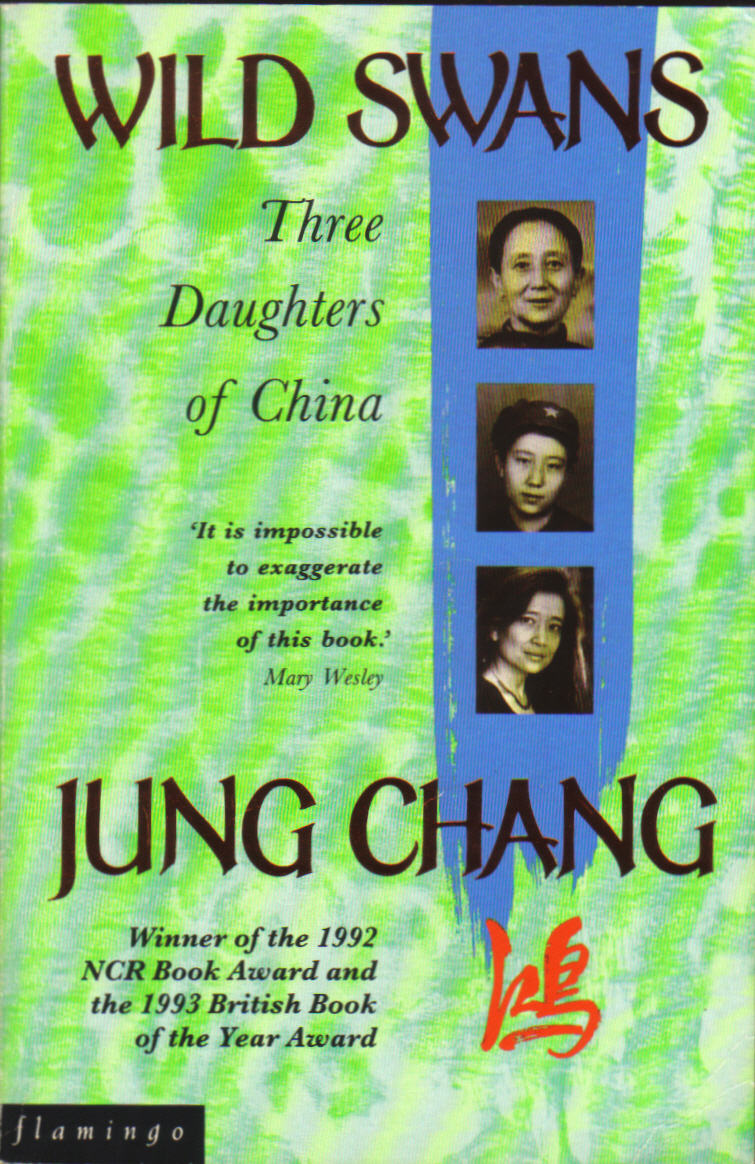
Wild Swans: Three Daughters of China

I am reading another book at the moment, which I will review when I finish it in the next week or so, but it is so slow and boring that I was looking around for something else to read. I picked up Wild Swans about 15 years ago, but didn't finish it. It was too confronting, I think. This time, I read it in two days. A bit more perspective probably helped me deal with the stark reality of the human rights abuses in China. I can't believe what so many people went through, but their hardships have certainly helped make them the fastest growing nation in the world today.


I read another review, which was a positive review overall, but it started out by saying how depressing this book is. I didn't find it depressing. I found it inspiring. It was certainly eye-opening and educational. The hardships suffered by tens of millions of Chinese had my chest tied up in knots. But I wasn't depressed. I felt strong, and I felt the strength of the author, Jung Change. She is inspirational, as is her mother and grandmother, whom the book is about. In fact, the Chinese people are an inspiration, for what they have endured and survived, and for what their nation has become.

Saturday, March 10, 2012

People of the Book

As part of the challenge to read more Australian novels by female authors, I finally read People of the Book by Geraldine Brooks. I have read A Year of Wonders before, and never really knew why everyone raved about Geraldine Brooks. Yes, her writing was fine, but they weren't outstanding. Having read People of the Book, now I know what all the fuss is about. This book is superb!


The historial education in this novel was what most appealed to me. The amount of research that Geraldine Brooks did for this novel is phenomenal. The information about religious history has been presented without an agenda, and has really opened my eyes to many things that I was oblivious of.
   People of the Book has been compared to Dan Brown's Da Vinci Code. I think the Da Vinci Code is a pale comparison.
   People of the Book won the Australian Book Industry Award in 2008.
   The main story running through this novel is of a book conservator who is responsible for restoring the Sarajevo Haggadah (which is a real book). The story alternates between Hanna (the conservator) in her investigations, and the (fictional) stories of the book's origin and its various survivals through times of upheaval for Jews in Europe.
   I loved this book - please read it, if you haven't already.

Thursday, March 8, 2012

March Prompt - A Classics Challenge

I read the best book this month, for this prompt! In March, those participating in the Classics Challenge have been asked a number of questions on a setting in their classic read.
   This month I read The Master and Margarita by Mikhail Bulgakov: here's my review.
   The setting is in the chapter entitled Satan's Rout! It is an amazing palace in which Satan holds his ball.
   The palace is clearly in another dimension from the world we know, or some kind of supernatural powers are at play, because the massive palace is all situated in a tiny fifth floor apartment in Moscow!


   It is speculated that the setting for Satan's ball is modelled off a Spring Festival that was hosted by the US Ambassador to the Soviet Union in 1935, which was held at Spaso House. Wikipedia says that the decorations surpassed imagination, with a forest of young birch trees being brought into the chandelier room, a dining table covered in Finnish tulips, and an avery made from fish netting full of pheasants, parakeets and one hundred zebra finches. There were also animals roaming around, on loan from the Moscow zoo. Mikhail Bulgakov apparently attended this Spring Festival, which gave him the inspiration for Satan's ball.


Like the rest of this bizarre and wonderful book, the Spring Ball that Satan hosts is a feat of imagination. Margarita is the hostess, and she is bathed in a special serum beforehand, which makes her young and beautiful, and she hosts the whole ball naked (but wearing amazing shoes made of rose petals). Margarita enters the palace through a lush jungle. The first room is full of white tulips, and there is a full orchestra. The next room was full of roses and camellias, with fountains of champagne. Another room contained a jazz band made up of chimpanzees, gibbons, mandrils and marmosets. Butterflies fly over the dancing guests. There is a massive pool with a crystal bottom, full of Brandy with people swimming in it. And there is a extremely grand staircase, at the top of which Margarita meets Satan's guests.
   The mood is certainly intoxicating, frivolous, and over-the-top. It is decadent, and demonstrates Satan flaunting his influence over humans who are too easily tempted to be drunk and naked, and romp with the devil!
   This setting is certainly the culmination of the storyline, and Bulgakov lets his imagination go most extravagantly!