
Tuesday, July 31, 2018


Friday, January 10, 2014
The Russian Concubine
I was in the mood for a fun read during the two weeks that I had off in December. I thought Kate Furnivall's The Russian Concubine would be that novel. I don't know why I wasted by time with it.

I cringed my way through the writing - it was so bad that I was conscious of it most of the way through the story, so couldn't fully immerse myself. So many cliches.
The history was interesting, but Belinda Alexander did a similar Russian refugee in China story, which was far superior.
The story was way too far-fetched, and the main character, a teenage girl who seemed to stomp her foot and get her own way all the time - she was the most annoying character ever. After putting everyone through a lot of unnecessary stress and pain, the character seems to grow up suddenly and leave the mess in her wake without a thought.
The longer I've thought about it, the worse I've thought of it.
I cringed my way through the writing - it was so bad that I was conscious of it most of the way through the story, so couldn't fully immerse myself. So many cliches.
The history was interesting, but Belinda Alexander did a similar Russian refugee in China story, which was far superior.
The story was way too far-fetched, and the main character, a teenage girl who seemed to stomp her foot and get her own way all the time - she was the most annoying character ever. After putting everyone through a lot of unnecessary stress and pain, the character seems to grow up suddenly and leave the mess in her wake without a thought.
The longer I've thought about it, the worse I've thought of it.
Sunday, January 5, 2014
A Farewell to Arms
Another classic that I've read in the last couple of months is Ernest Hemingway's A Farewell To Arms.

I really enjoyed the writing in this novel. The narrator stuck to the rule that saying less says more, and the way that the dialogue was written was refreshing - banter between the men, the wit and sarcasm, and the humour that the characters use to cope.
The story was very simple and touching (at some times in the middle even feeling a bit aimless), the relationships between the characters were well constructed - the relationship between the narrator, Lieutenant Henry, and his girlfriend Catherine Barkley, and similarly between the narrator and his soldier colleagues (both subordinates and fellow officers).
I am still touched by this book, and still feel its essence, even though I finished it weeks ago. I could only ever aspire to write like Hemingway.

I really enjoyed the writing in this novel. The narrator stuck to the rule that saying less says more, and the way that the dialogue was written was refreshing - banter between the men, the wit and sarcasm, and the humour that the characters use to cope.
The story was very simple and touching (at some times in the middle even feeling a bit aimless), the relationships between the characters were well constructed - the relationship between the narrator, Lieutenant Henry, and his girlfriend Catherine Barkley, and similarly between the narrator and his soldier colleagues (both subordinates and fellow officers).
I am still touched by this book, and still feel its essence, even though I finished it weeks ago. I could only ever aspire to write like Hemingway.
Saturday, January 4, 2014
The White Tiger
The White Tiger by Aravind Adiga was the winner of the Man Booker Prize in 2008. But I didn't enjoy it. It wasn't the worst thing that I've read in the last couple of months, but I was certainly disappointed.

I think the main reason for my disappointment was the writing itself. I understand that the narrator is an uneducated Indian, but I didn't like the format of the letters, nor did I like the simplicity of the language. More so, on reflection, I don't think I liked the voice of the narrator at all.
In some ways I have to forgive these reasons, because I have not read anything else by Aravind Adiga. For all I know, the writing style perfectly reflected the character of the narrator - who was not a very nice person. In which case, the reasons I so disliked this book are actually very clever writing techniques. But, I can't completely forgive these things - it could have been written from an omnipresent narrator, and the story would still have been a striking a depiction of India.
The reviews called it 'blazingly savage and brilliant', but it's probably just the truth. The truth is savage, and the hot Indian sun makes that savagery blazing! I have no doubt of the corruption, and the dramatic differences between the poor and the middle class that exist in any country dragging itself into the first-world. It doesn't make this book a masterpiece, but it is a story that will take you away from your comfortable bedroom for a few hours.
Nineteen Eighty-Four
I read George Orwell's Nineteen Eighty-Four in the last months of 2013. This is one of the classics on my list to read.

What struck me the most about Nineteen Eighty-Four was that it was clear when it was published, and even for decades afterwards, that it was a reflection on communism in Russia. But as a modern reader, I think that this futurist horror story is far more broadly applicable. The control of information is terrifying, particularly the manipulation of historical records and even journalism. Society in Oceania is also highly regulated, which our current society is increasingly becoming. Even the language was being reduced down to official language that took away expression, and perhaps the increasing use of acronyms in certain circles of our own society is another reflection of this.

I think this is a book for all ages, all times, and the name could continually be changed to be twenty or thirty years ahead of the reader, and it would still be so relevant. It points our the dangers of authoritarianism, the degradation of the individual, and what can happen when power is completely taken away by dictators. The complete terror that Winston is living in, the terror that has kept him compliant all his life, is palpable. Then the terror of the torture and the reeducation is also teeth-grindingly present.
The writing is beautiful. It is not difficult, it is not cliche, it is not preaching, and it probably rewards the reader with something new every time it is picked up. I can't wait to read this again. A true masterpiece.

What struck me the most about Nineteen Eighty-Four was that it was clear when it was published, and even for decades afterwards, that it was a reflection on communism in Russia. But as a modern reader, I think that this futurist horror story is far more broadly applicable. The control of information is terrifying, particularly the manipulation of historical records and even journalism. Society in Oceania is also highly regulated, which our current society is increasingly becoming. Even the language was being reduced down to official language that took away expression, and perhaps the increasing use of acronyms in certain circles of our own society is another reflection of this.

I think this is a book for all ages, all times, and the name could continually be changed to be twenty or thirty years ahead of the reader, and it would still be so relevant. It points our the dangers of authoritarianism, the degradation of the individual, and what can happen when power is completely taken away by dictators. The complete terror that Winston is living in, the terror that has kept him compliant all his life, is palpable. Then the terror of the torture and the reeducation is also teeth-grindingly present.
The writing is beautiful. It is not difficult, it is not cliche, it is not preaching, and it probably rewards the reader with something new every time it is picked up. I can't wait to read this again. A true masterpiece.
Wednesday, January 1, 2014
Slack … though some small achievement
So, I've been very busy. In 2013, I've done no writing at all, and to be honest, not as much reading as I wanted to. I have also let my posts slip - I've got a few more books to review since my last post, and have just had them sitting in a pile for nearly two months. The books have stared at me and made me feel guilty about my procrastination. So I need to catch up … and my expectations for myself in 2014 won't be as high, so I don't feel so guilty when I don't achieve them.
In 2013, my computer crashed, the hard drive completely died, and I lost a lot of notes and research that I had done for my novel. So my new year's resolution is to use DropBox for most of my work, and to back up on a USD drive. My external hard drive also died - overheated because the fan stopped - so I won't rely on an external drive and automatic backup system anymore either. All this was really disappointing, and I feel like I'm starting from scratch.
I'm also struggling to find time to read, and I have less patience for bad writing. I'll liking the classics more and more, and have recently read a popular book in which the writing was so bad that I was cringing most of the way through and couldn't concentrate on the story (but you can read my next couple of reviews and work out which book that was for yourself.

One thing I did achieve this year, is that I did complete the 2013 Aussie Author Challenge by reading the following novels:
Secret Keeper by Kate Morton
Carpentaria by Alexis Wright
The Harp in the South by Ruth Park
The Odd Angry Shot by William Nagle
The Engagement by Chloe Hooper
On the Jellicoe Road by Melina Marchetta
The Secret River by Kate Grenville
Remembering Babylon by David Malouf
Finnikin of the Rock by Melina Marchetta
1788 by Watkin Tench, edited by Tim Flannery
Rose By Any Other Name by Maureen McCarthy
Bush Studies by Barbara Baynton
Chain of Hearts by Maureen McCarthy
Batavia by Peter Fitzsimons
The Daughters of Mars by Thomas Keneally
The Turning by Tim Winton
The Rosie Project by Graeme Simsion
The Great Melbourne Cup Mystery by Arthur Upfield
In 2013, my computer crashed, the hard drive completely died, and I lost a lot of notes and research that I had done for my novel. So my new year's resolution is to use DropBox for most of my work, and to back up on a USD drive. My external hard drive also died - overheated because the fan stopped - so I won't rely on an external drive and automatic backup system anymore either. All this was really disappointing, and I feel like I'm starting from scratch.
I'm also struggling to find time to read, and I have less patience for bad writing. I'll liking the classics more and more, and have recently read a popular book in which the writing was so bad that I was cringing most of the way through and couldn't concentrate on the story (but you can read my next couple of reviews and work out which book that was for yourself.

One thing I did achieve this year, is that I did complete the 2013 Aussie Author Challenge by reading the following novels:
Secret Keeper by Kate Morton
Carpentaria by Alexis Wright
The Harp in the South by Ruth Park
The Odd Angry Shot by William Nagle
The Engagement by Chloe Hooper
On the Jellicoe Road by Melina Marchetta
The Secret River by Kate Grenville
Remembering Babylon by David Malouf
Finnikin of the Rock by Melina Marchetta
1788 by Watkin Tench, edited by Tim Flannery
Rose By Any Other Name by Maureen McCarthy
Bush Studies by Barbara Baynton
Chain of Hearts by Maureen McCarthy
Batavia by Peter Fitzsimons
The Daughters of Mars by Thomas Keneally
The Turning by Tim Winton
The Rosie Project by Graeme Simsion
The Great Melbourne Cup Mystery by Arthur Upfield
At least what little I have read this year has been broad ranging, diverse and balanced.
Sunday, November 3, 2013
The Great Melbourne Cup Mystery
Of all the Arthur Upfield books I could have started with, I think I chose The Great Melbourne Cup Mystery because is in the spring racing season here in Victoria, and I went to the Melbourne Cup Tour recently at Mitchelton Winery. It was a great introduction to Mr Upfield, and I'm going to indulge in more in the future!

I think he was writing mostly in the 1920s and 1930s. The introduction to this novel spoke about how most of his novels weren't published until after he was dead. Instead they were published as serials in the newspaper, written week to week with very quick deadlines.
The language is true to the times, particularly the way that the characters spoke. From his writing, it's also apparent that he had a strong connection to rural areas and people, and seems not to be naive about the realities of particular industries (such as the horse racing industry in this case).
His novels are many mysteries, and he went on to write lots (29) of novels with a main character who was an Aboriginal half-caste, detective Bony. From having read this novel (and another one which I will write up in a couple of weeks), so far his mysteries are excellent. They are not like modern mysteries where the investigators rely heavily on forensic science and technology. The detectives in Upfield's novels use their brains, and speak to people. The other fresh thing about his writing is that there are no clues to the reader about who has done it - it truly is a mystery all the way until the detective reveals the solution to the readers and the criminals together.
Simply written, but really endearing, and truly captures the feeling of the time.

I think he was writing mostly in the 1920s and 1930s. The introduction to this novel spoke about how most of his novels weren't published until after he was dead. Instead they were published as serials in the newspaper, written week to week with very quick deadlines.
The language is true to the times, particularly the way that the characters spoke. From his writing, it's also apparent that he had a strong connection to rural areas and people, and seems not to be naive about the realities of particular industries (such as the horse racing industry in this case).
His novels are many mysteries, and he went on to write lots (29) of novels with a main character who was an Aboriginal half-caste, detective Bony. From having read this novel (and another one which I will write up in a couple of weeks), so far his mysteries are excellent. They are not like modern mysteries where the investigators rely heavily on forensic science and technology. The detectives in Upfield's novels use their brains, and speak to people. The other fresh thing about his writing is that there are no clues to the reader about who has done it - it truly is a mystery all the way until the detective reveals the solution to the readers and the criminals together.
Simply written, but really endearing, and truly captures the feeling of the time.
Saturday, October 12, 2013
The Rosie Project
This lovely little romance novel, The Rosie Project by Graeme Simsion, was a pleasure to read. I had seen a view on the ABC's Book Club, and knew I had to read this Aussie novel that had become so popular.

From Good Reads: "Narrator Don Tillman 39, Melbourne genetics prof and Gregory Peck lookalike, sets a 16-page questionnaire The Wife Project to find a non-smoker, non-drinker ideal match. But Rosie and her Father Projectsupersede. The spontaneous always-late smoker-drinker wants to find her biological father. She resets his clock, throws off his schedule, and turns his life topsy-turvy."
What makes this novel unique and endearing it the main character, Don. He is clearly autistic, and his friends are trying to get him to self-diagnose by dropping hints. But, although he is very realistic about his lack of social abilities, he does not draw the link between the symptoms of Aspergers syndrome and himself.
He doesn't think that he feels like others do, and he's probably right, but that doesn't mean that he doesn't feel at all. So he comes to realise that he does feel love, which is just the most heart-warming moment that I have read in a book for a long time.
Typical romance, with a twist. Really enjoyable.

From Good Reads: "Narrator Don Tillman 39, Melbourne genetics prof and Gregory Peck lookalike, sets a 16-page questionnaire The Wife Project to find a non-smoker, non-drinker ideal match. But Rosie and her Father Projectsupersede. The spontaneous always-late smoker-drinker wants to find her biological father. She resets his clock, throws off his schedule, and turns his life topsy-turvy."
What makes this novel unique and endearing it the main character, Don. He is clearly autistic, and his friends are trying to get him to self-diagnose by dropping hints. But, although he is very realistic about his lack of social abilities, he does not draw the link between the symptoms of Aspergers syndrome and himself.
He doesn't think that he feels like others do, and he's probably right, but that doesn't mean that he doesn't feel at all. So he comes to realise that he does feel love, which is just the most heart-warming moment that I have read in a book for a long time.
Typical romance, with a twist. Really enjoyable.
Wednesday, September 25, 2013
The Turning
Another novel for the Aussie Author Challenge, this is actually a collection of short stories that web together through various connections. The Turning by Tim Winton, which is apparently due to be released in cinemas as a movie. Really interestingly done, but not sure how the beauty of the book is going to translate to the screen ...

It's about ordinary lives, set over the last few decades, set in various times, with various main characters, various tenses and narrators. It's generally set in small coast towns of Western Australia, though usually not specified.
There's drugs, violence, despair, grief, estrangement, regret, sentimentality, companionship, soul-searching and love. Often the short stories come back to Vic Lang, who appears in a number of stories either directly or indirectly. Other characters are loosely linked as well. Initially, I was confused, but I let go and really enjoyed the voices, stories and journey.
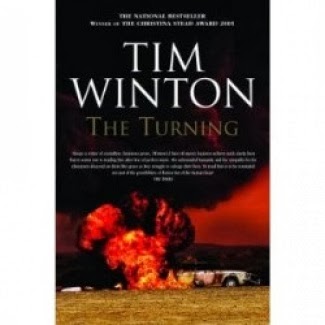
It's about ordinary lives, set over the last few decades, set in various times, with various main characters, various tenses and narrators. It's generally set in small coast towns of Western Australia, though usually not specified.
There's drugs, violence, despair, grief, estrangement, regret, sentimentality, companionship, soul-searching and love. Often the short stories come back to Vic Lang, who appears in a number of stories either directly or indirectly. Other characters are loosely linked as well. Initially, I was confused, but I let go and really enjoyed the voices, stories and journey.
Sunday, September 15, 2013
The Daughters of Mars
Another book for the Aussie Author Challenge: I read The Daughters of Mars by Thomas Keneally. This was my first Thomas Keneally book, and I absolutely loved the language. This book was set during the first world war, and the language that he uses, not only with the dialogue, is suited to the time. Beautiful.

Naomi and Sally Durance are daughters of a dairy farmer. They escape their the tedium of their lives, and the guilty of having euthanised their mother, when the call for nurses is made in the Great War. The novel has a vast scope, from Africa to Gallipoli, to France and the Eastern Front. But it remains very intimate, closely following these strong sisters caught up in the great mill of history.
It is interesting that the ending is alternate - you don't really know what happens, and you can imagine their either ending is just as plausible.
I really enjoyed this novel, and am now a keen Thomas Keneally fan!

Naomi and Sally Durance are daughters of a dairy farmer. They escape their the tedium of their lives, and the guilty of having euthanised their mother, when the call for nurses is made in the Great War. The novel has a vast scope, from Africa to Gallipoli, to France and the Eastern Front. But it remains very intimate, closely following these strong sisters caught up in the great mill of history.
It is interesting that the ending is alternate - you don't really know what happens, and you can imagine their either ending is just as plausible.
I really enjoyed this novel, and am now a keen Thomas Keneally fan!
Sunday, August 18, 2013
Batavia
Another Australian novel for the Aussie Author Challenge; I recently finished Batavia by Peter Fitzsimons. I am a fan of Peter's writing - he makes history very accessible and turns the historical figures into three-dimensional (living and breathing) characters. This novel about the ship wrecked Batavia was no different.

This story is truly horrific, and hard to believe that it could actually happen. But they do say that real life is often stranger than fiction. I know that Peter will have taken some liberties in developing character traits, but they can't have been too much of a stretch, since true evil must have existed for these events to have occurred.
So in the 1600s, a huge ship, travelling for the Dutch East India Company from the Netherlands to Indonesia on a spice run (and carrying a huge fortune of bullion) hit a reef off Geraldton in WEstern Australia and sunk. It was the ship's maiden voyage. The survivors got themselves into low islands along the belt of reefs. The captain of the ship took one of the long boats and got themselves up to Indonesia to return with another ship to rescue those stranded.
In the meantime, the survivors became divided by the scheming of the 2IC on the Batavia. Gratuitous murder began, along with rape, the division and isolation of groups, bribery and captivity. Of the original 341 people on board the Batavia, only 68 survived!
Peter's writing brings the history to life in an extremely readable, page-turning form. It is well researched, but presented in such a way that is not just listing facts.
This story is truly horrific, and hard to believe that it could actually happen. But they do say that real life is often stranger than fiction. I know that Peter will have taken some liberties in developing character traits, but they can't have been too much of a stretch, since true evil must have existed for these events to have occurred.
So in the 1600s, a huge ship, travelling for the Dutch East India Company from the Netherlands to Indonesia on a spice run (and carrying a huge fortune of bullion) hit a reef off Geraldton in WEstern Australia and sunk. It was the ship's maiden voyage. The survivors got themselves into low islands along the belt of reefs. The captain of the ship took one of the long boats and got themselves up to Indonesia to return with another ship to rescue those stranded.
In the meantime, the survivors became divided by the scheming of the 2IC on the Batavia. Gratuitous murder began, along with rape, the division and isolation of groups, bribery and captivity. Of the original 341 people on board the Batavia, only 68 survived!
Peter's writing brings the history to life in an extremely readable, page-turning form. It is well researched, but presented in such a way that is not just listing facts.
Sunday, August 4, 2013
Chain of Hearts
Another novel for the Aussie Author Challenge, but it is a repeat author for this year - I read Chain of Hearts by Maureen McCarthy.

Like Rose By Any Other Name, the central character is a teenage girl with issues. Maureen McCarthy can capture the inner turmoil very well, and the story really takes you into the girl's heard.
After suffering a trauma that she hasn't dealt with, Sophie has become a problem teenager for her perfect parents, and is shipped off to live with her Aunt in a peaceful outback Australian town. She feels ditched and rejected, but has nothing else to do but get to know her Aunt and other towns people. She learns empathy and the ability to put herself in someone else's shoes.
The pace is really good, and each character is gradually built up. There are a number of different narrators, with each building their own story, jumping backwards to past events and then back to present time.
A simple, yet wonderful story - it is about family, friendships, learning to forgive and tolerate others despite differences. I really enjoyed it.
Like Rose By Any Other Name, the central character is a teenage girl with issues. Maureen McCarthy can capture the inner turmoil very well, and the story really takes you into the girl's heard.
After suffering a trauma that she hasn't dealt with, Sophie has become a problem teenager for her perfect parents, and is shipped off to live with her Aunt in a peaceful outback Australian town. She feels ditched and rejected, but has nothing else to do but get to know her Aunt and other towns people. She learns empathy and the ability to put herself in someone else's shoes.
The pace is really good, and each character is gradually built up. There are a number of different narrators, with each building their own story, jumping backwards to past events and then back to present time.
A simple, yet wonderful story - it is about family, friendships, learning to forgive and tolerate others despite differences. I really enjoyed it.
Thursday, August 1, 2013
Bush Studies
As part of my goal to complete the 2013 Aussie Author Challenge, I read Barbara Baynton's Bush Studies. It is a collection of short Australian stories, published in 1902.

In some ways, I think the writing in these short stories is very modern. It is abstract. And in some cases, very hard to follow.
The stories also deal with abuse of women, and the treatment of women in isolated colonies. It depicts a hard life, and I wonder about Bayton's own existence, and the women she met who influenced her stories.
"Squeaker's Mater" would be her best story, particularly the beginning, how Baynton uses such short sentences to describe such a strong and capable woman being struck down.
The "Bush Church" story, I found, held a lot of black humour. Baynton is able to paint a picture of these people in such a short time, and they are very vivid.
Her ability to portray a scene vividly is doubly true in the short story "The Chosen Vessel", where an isolated woman's terror is depicted and then realised!
I think I'll have to read these short stories again, so that I fully understand them, because I think I missed the gist of a couple of them. They are not easy to read, but I think I admire Baynton a lot.

In some ways, I think the writing in these short stories is very modern. It is abstract. And in some cases, very hard to follow.
The stories also deal with abuse of women, and the treatment of women in isolated colonies. It depicts a hard life, and I wonder about Bayton's own existence, and the women she met who influenced her stories.
"Squeaker's Mater" would be her best story, particularly the beginning, how Baynton uses such short sentences to describe such a strong and capable woman being struck down.
The "Bush Church" story, I found, held a lot of black humour. Baynton is able to paint a picture of these people in such a short time, and they are very vivid.
Her ability to portray a scene vividly is doubly true in the short story "The Chosen Vessel", where an isolated woman's terror is depicted and then realised!
I think I'll have to read these short stories again, so that I fully understand them, because I think I missed the gist of a couple of them. They are not easy to read, but I think I admire Baynton a lot.
Sunday, July 28, 2013
Rose By Any Other Name
Another Australian author, I read Maureen McCarthy's Rose By Any Other Name. I really enjoyed it, as a light-hearted, quick read. There was a lot of teenage angst (which was probably more suited to a thirteen or fourteen year-old than a nineteen year old), but it was still convincing.

With good character development, the story is fairly simple and believable - it's just about families, and the various members of the family going through various crises. It was good not to read about perfect characters.
The pace was really good - the timeline kept jumping from the present to events 12 months prior, which kept the story moving forward. The narrator jumped around, and gave very little away in the present-day narration, which was why the story kept jumping back to memories. The narrator wasn't reliable - the story was very tainted with emotion, but the narrator eventually became empathetic to the other characters, which symbolised the growth of the main character.
For a good summer read on the beach, or a rainy weekend in bed, this is perfect.
With good character development, the story is fairly simple and believable - it's just about families, and the various members of the family going through various crises. It was good not to read about perfect characters.
The pace was really good - the timeline kept jumping from the present to events 12 months prior, which kept the story moving forward. The narrator jumped around, and gave very little away in the present-day narration, which was why the story kept jumping back to memories. The narrator wasn't reliable - the story was very tainted with emotion, but the narrator eventually became empathetic to the other characters, which symbolised the growth of the main character.
For a good summer read on the beach, or a rainy weekend in bed, this is perfect.
Monday, July 22, 2013
The Virgin's Lover
I had some fun and read Philippa Gregory's The Virgin's Lover. I really enjoy her books - they bring history to life.

This novel is about the first years of Elizabeth's reign. It's before she decides to never marry, and there are lots of suitors and scandal.
This novel is about the first years of Elizabeth's reign. It's before she decides to never marry, and there are lots of suitors and scandal.
Saturday, July 20, 2013
1788
This book, 1788, is by Watkin Tench, written during his time as a marine office on the First Fleet and his experience of the arrival and his first four years in the Australian colony. Whilst originally published in 1789, and later parts published subsequently, this version has been edited by Tim Flannery.

Clearly, this book was a non-fiction, but it was written in a style that followed well and was very captivating. Either the language of 1788 translates very well, or Tim Flannery has done a great job in editing.
I enjoyed this book a lot. Watkin Tench was, I think, a very studious observer and liberal thinker. His observations focus a lot on the environment and the Aboriginals. It was interesting to read and the real characters after which many of the Sydney landmarks are named - Bennelong (the site of the Sydney Opera House) and Barangaroo (the newest and most controversial Sydney harbour development) were in fact lovers, with Bennelong being one of the most approachable Aboriginals who learnt the language and customs of the whites the quickest, and then merged in and out of each culture as he chose.
This book has actually left a very profound effect on me - I always thought that the first settlors were stumbling fools and quite ignorant. Watkin Tench has changed this for me, and in a way, I think he is now one of my heros. I just wish that more of our founders were like him.

Clearly, this book was a non-fiction, but it was written in a style that followed well and was very captivating. Either the language of 1788 translates very well, or Tim Flannery has done a great job in editing.
I enjoyed this book a lot. Watkin Tench was, I think, a very studious observer and liberal thinker. His observations focus a lot on the environment and the Aboriginals. It was interesting to read and the real characters after which many of the Sydney landmarks are named - Bennelong (the site of the Sydney Opera House) and Barangaroo (the newest and most controversial Sydney harbour development) were in fact lovers, with Bennelong being one of the most approachable Aboriginals who learnt the language and customs of the whites the quickest, and then merged in and out of each culture as he chose.
This book has actually left a very profound effect on me - I always thought that the first settlors were stumbling fools and quite ignorant. Watkin Tench has changed this for me, and in a way, I think he is now one of my heros. I just wish that more of our founders were like him.
Monday, July 15, 2013
Finnikin of the Rock
A young-adult fantasy novel by Australian author Melina Marchetta. I was hoping that this would have the beautiful character development and emotional connection that her other young adult novels evoke. But it didn't.

I didn't like it. Not much else to say. I think I didn't like it because the characters didn't appeal to me - I didn't love them, or get invested in their mission, nor did I even dislike them. The characters evoked on feelings in me, and nor did the purpose of the characters. I will return to reading Melina's books that are not fantasy stories, because they really are wonderful.
I didn't like it. Not much else to say. I think I didn't like it because the characters didn't appeal to me - I didn't love them, or get invested in their mission, nor did I even dislike them. The characters evoked on feelings in me, and nor did the purpose of the characters. I will return to reading Melina's books that are not fantasy stories, because they really are wonderful.
Friday, July 5, 2013
Remembering Babylon
This short novel by David Malouf reminded me of That Deadman Dance by Kim Scott, though it was much shorter and left more gaps for the reader's imagination to fill. Written in 1993, Remembering Babylon won the IMPAC Award, and was shortlisted for the Miles Franklin award and the Man Booker Prize.

The reason that it reminds me of That Deadman Dance is probably because it is about a pioneer settlement on the fringes of other early Australian settlements, and it involves Aboriginals. In That Deadman Dance, it was an Aboriginal that was cared for and became part of the white society, and then didn't fit in with either communities. Remembering Babylon is the reverse - it is about a young white boy who gets thrown off a ship whilst ill, and lives among remote Aboriginals in Northern Queensland for half his life. Once white settlement starts moving as far north as the tribe he is with, he ventures back to his own kind. But he has nearly completely lost the English language, and most of the English body language as well. It is about isolation, racism, and community. His very presence in the community divides it into two: those who will tolerate and in time love him, and those that are determined to drive him away (from fear of something different).
The voice of the narrator is very stable and removed, which distinguishes this novel even further from That Deadman Dance. Despite being distant (allowing quite lovely descriptive prose), the narrator often has quite profound insight into the characters (which is the only way that you get to know them well, because their description is not focused on). Having such a detached narrator really allows your own feelings to guide you, inside of being guided by a main character's feelings. I suppose this allows for a very broad range of responses to the novel, based on a reader's own background and sensitivities.
The narrator does take on some traits of the race of characters that the story is focusing on. The description of the landscape is very different when the characters are white (it is always a very hot, stark and feeling of being crowded-in by the bush) and when they are Aboriginal (there seems to be magic in the bush, as well as a peaceful silence). The only time that the whites seem to be clam in their surroundings is when they are at the house of the lady bee-keeper.
As well as describing the landscape magically, David Malouf also has some beautiful prose describing some of the cultural and spiritual aspects of the Aboriginal people. I have never read anything that expressed and explained another races' culture so well.
The only downfall with this short novel is that it just short of dribbles off into a nothing ending ...
The reason that it reminds me of That Deadman Dance is probably because it is about a pioneer settlement on the fringes of other early Australian settlements, and it involves Aboriginals. In That Deadman Dance, it was an Aboriginal that was cared for and became part of the white society, and then didn't fit in with either communities. Remembering Babylon is the reverse - it is about a young white boy who gets thrown off a ship whilst ill, and lives among remote Aboriginals in Northern Queensland for half his life. Once white settlement starts moving as far north as the tribe he is with, he ventures back to his own kind. But he has nearly completely lost the English language, and most of the English body language as well. It is about isolation, racism, and community. His very presence in the community divides it into two: those who will tolerate and in time love him, and those that are determined to drive him away (from fear of something different).
The voice of the narrator is very stable and removed, which distinguishes this novel even further from That Deadman Dance. Despite being distant (allowing quite lovely descriptive prose), the narrator often has quite profound insight into the characters (which is the only way that you get to know them well, because their description is not focused on). Having such a detached narrator really allows your own feelings to guide you, inside of being guided by a main character's feelings. I suppose this allows for a very broad range of responses to the novel, based on a reader's own background and sensitivities.
The narrator does take on some traits of the race of characters that the story is focusing on. The description of the landscape is very different when the characters are white (it is always a very hot, stark and feeling of being crowded-in by the bush) and when they are Aboriginal (there seems to be magic in the bush, as well as a peaceful silence). The only time that the whites seem to be clam in their surroundings is when they are at the house of the lady bee-keeper.
As well as describing the landscape magically, David Malouf also has some beautiful prose describing some of the cultural and spiritual aspects of the Aboriginal people. I have never read anything that expressed and explained another races' culture so well.
The only downfall with this short novel is that it just short of dribbles off into a nothing ending ...
Sunday, June 30, 2013
The Secret River
I just finished reading The Secret River by Kate Grenville, which is one of the 10 Aussie books to read before you die. Whilst writing this book, I just learnt that it is a part of a trilogy - it is a great stand-alone story, but it's good enough that I want more! So I will be reading the others as soon as I can.

Winner of the Commonwealth Prize for Literature, the Christina Stead Prize for fiction (NSW Premier's Prize), the Community Relations Commission Prize, the Bookseller's Choice Award, the Fellowship of Australian Writers Prize and the Publishing Industry Book of the Year Award. It was also shortlisted for the Miles Franklin Award and the Man Booker Prize. So, it was well received!
It's about the settling of the Hawkesbury river, near Sydney. William Thornhill is transported in 1806 from a life of poverty in London, to the struggle he faces on the frontier of a new settlement, but the prosperous lifestyle that results from his hard work.
Unlike other similar stories along the same theme, the dark side of this story is the way the settlers deal with the local Darug Aboriginal people. Kate Grenville doesn't shy away from the racism and the attitudes of the time. It is confronting, and deals with the peer pressure within a small community of settlers. The main character is not a smart man, and he cannot express himself well, let alone explain or acknowledge his own feelings to himself. He grapples with knowing that the Aboriginal people are human beings like himself, yet keeps drawing distinctions to justify his actions and the actions of others - although he is repulsed by those actions at the same time.
Unlike some of the others that made the list of 10 Aussie Books You Must Read, this one really is!
Winner of the Commonwealth Prize for Literature, the Christina Stead Prize for fiction (NSW Premier's Prize), the Community Relations Commission Prize, the Bookseller's Choice Award, the Fellowship of Australian Writers Prize and the Publishing Industry Book of the Year Award. It was also shortlisted for the Miles Franklin Award and the Man Booker Prize. So, it was well received!
It's about the settling of the Hawkesbury river, near Sydney. William Thornhill is transported in 1806 from a life of poverty in London, to the struggle he faces on the frontier of a new settlement, but the prosperous lifestyle that results from his hard work.
Unlike other similar stories along the same theme, the dark side of this story is the way the settlers deal with the local Darug Aboriginal people. Kate Grenville doesn't shy away from the racism and the attitudes of the time. It is confronting, and deals with the peer pressure within a small community of settlers. The main character is not a smart man, and he cannot express himself well, let alone explain or acknowledge his own feelings to himself. He grapples with knowing that the Aboriginal people are human beings like himself, yet keeps drawing distinctions to justify his actions and the actions of others - although he is repulsed by those actions at the same time.
Unlike some of the others that made the list of 10 Aussie Books You Must Read, this one really is!
Tuesday, June 25, 2013
On the Jellicoe Road
This is a young adult novel by Australian author Melina Marchetta, which won the West Australia Young Readers Book Award in 2008, and the Michael L. Printz Award in the USA in 2009. It is a great story, and it reminds you how much emotion teenagers feel during those years, and how formative the teens can be.

It's set around a boarding school on the Jellicoe Road in regional New South Wales. The school mainly seems to be for gifted troubled children, and Melina Marchetta taps into the teenage angst very well. But the characters are still endearing, and you really want them to find stability and happiness.
Heartrending at times, I admire how these teenagers act and their approach to life, despite everything that they have been through. It gave me a lot of hope that people, with the support of good friends, can make it through anything.
I have read a couple of books recently with endings that seemed premature. This doesn't do that - and it is so satisfying. There were a few places where I thought "Oh, no. It's going to end here", but it continued on and tied up every loose end very neatly, and left me with such a glowing feeling at the end. A perfect young adult book.
It's set around a boarding school on the Jellicoe Road in regional New South Wales. The school mainly seems to be for gifted troubled children, and Melina Marchetta taps into the teenage angst very well. But the characters are still endearing, and you really want them to find stability and happiness.
Heartrending at times, I admire how these teenagers act and their approach to life, despite everything that they have been through. It gave me a lot of hope that people, with the support of good friends, can make it through anything.
I have read a couple of books recently with endings that seemed premature. This doesn't do that - and it is so satisfying. There were a few places where I thought "Oh, no. It's going to end here", but it continued on and tied up every loose end very neatly, and left me with such a glowing feeling at the end. A perfect young adult book.
Subscribe to:
Posts (Atom)