Showing posts with label Australian. Show all posts

Sunday, November 3, 2013

The Great Melbourne Cup Mystery

Of all the Arthur Upfield books I could have started with, I think I chose The Great Melbourne Cup Mystery because is in the spring racing season here in Victoria, and I went to the Melbourne Cup Tour recently at Mitchelton Winery. It was a great introduction to Mr Upfield, and I'm going to indulge in more in the future!


I think he was writing mostly in the 1920s and 1930s. The introduction to this novel spoke about how most of his novels weren't published until after he was dead. Instead they were published as serials in the newspaper, written week to week with very quick deadlines.
   The language is true to the times, particularly the way that the characters spoke. From his writing, it's also apparent that he had a strong connection to rural areas and people, and seems not to be naive about the realities of particular industries (such as the horse racing industry in this case).
   His novels are many mysteries, and he went on to write lots (29) of novels with a main character who was an Aboriginal half-caste, detective Bony. From having read this novel (and another one which I will write up in a couple of weeks), so far his mysteries are excellent. They are not like modern mysteries where the investigators rely heavily on forensic science and technology. The detectives in Upfield's novels use their brains, and speak to people. The other fresh thing about his writing is that there are no clues to the reader about who has done it - it truly is a mystery all the way until the detective reveals the solution to the readers and the criminals together.
  Simply written, but really endearing, and truly captures the feeling of the time.

Wednesday, September 25, 2013

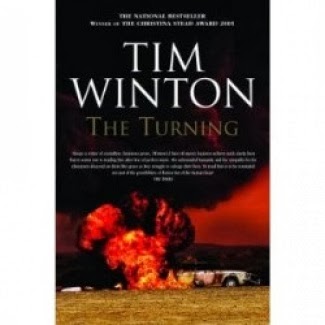
The Turning

Another novel for the Aussie Author Challenge, this is actually a collection of short stories that web together through various connections. The Turning by Tim Winton, which is apparently due to be released in cinemas as a movie. Really interestingly done, but not sure how the beauty of the book is going to translate to the screen ...


It's about ordinary lives, set over the last few decades, set in various times, with various main characters, various tenses and narrators. It's generally set in small coast towns of Western Australia, though usually not specified.
   There's drugs, violence, despair, grief, estrangement, regret, sentimentality, companionship, soul-searching and love. Often the short stories come back to Vic Lang, who appears in a number of stories either directly or indirectly. Other characters are loosely linked as well. Initially, I was confused, but I let go and really enjoyed the voices, stories and journey.

Thursday, August 1, 2013

Bush Studies

As part of my goal to complete the 2013 Aussie Author Challenge, I read Barbara Baynton's Bush Studies. It is a collection of short Australian stories, published in 1902.


In some ways, I think the writing in these short stories is very modern. It is abstract. And in some cases, very hard to follow.
   The stories also deal with abuse of women, and the treatment of women in isolated colonies. It depicts a hard life, and I wonder about Bayton's own existence, and the women she met who influenced her stories.
   "Squeaker's Mater" would be her best story, particularly the beginning, how Baynton uses such short sentences to describe such a strong and capable woman being struck down.
   The "Bush Church" story, I found, held a lot of black humour. Baynton is able to paint a picture of these people in such a short time, and they are very vivid.
   Her ability to portray a scene vividly is doubly true in the short story "The Chosen Vessel", where an isolated woman's terror is depicted and then realised!
   I think I'll have to read these short stories again, so that I fully understand them, because I think I missed the gist of a couple of them. They are not easy to read, but I think I admire Baynton a lot.

Sunday, July 28, 2013

Rose By Any Other Name

Another Australian author, I read Maureen McCarthy's Rose By Any Other Name. I really enjoyed it, as a light-hearted, quick read. There was a lot of teenage angst (which was probably more suited to a thirteen or fourteen year-old than a nineteen year old), but it was still convincing.


With good character development, the story is fairly simple and believable - it's just about families, and the various members of the family going through various crises. It was good not to read about perfect characters.
   The pace was really good - the timeline kept jumping from the present to events 12 months prior, which kept the story moving forward. The narrator jumped around, and gave very little away in the present-day narration, which was why the story kept jumping back to memories. The narrator wasn't reliable - the story was very tainted with emotion, but the narrator eventually became empathetic to the other characters, which symbolised the growth of the main character.
   For a good summer read on the beach, or a rainy weekend in bed, this is perfect.

Saturday, July 20, 2013

1788

This book, 1788, is by Watkin Tench, written during his time as a marine office on the First Fleet and his experience of the arrival and his first four years in the Australian colony. Whilst originally published in 1789, and later parts published subsequently, this version has been edited by Tim Flannery.


Clearly, this book was a non-fiction, but it was written in a style that followed well and was very captivating. Either the language of 1788 translates very well, or Tim Flannery has done a great job in editing.
   I enjoyed this book a lot. Watkin Tench was, I think, a very studious observer and liberal thinker. His observations focus a lot on the environment and the Aboriginals. It was interesting to read and the real characters after which many of the Sydney landmarks are named - Bennelong (the site of the Sydney Opera House) and Barangaroo (the newest and most controversial Sydney harbour development) were in fact lovers, with Bennelong being one of the most approachable Aboriginals who learnt the language and customs of the whites the quickest, and then merged in and out of each culture as he chose.
   This book has actually left a very profound effect on me - I always thought that the first settlors were stumbling fools and quite ignorant. Watkin Tench has changed this for me, and in a way, I think he is now one of my heros. I just wish that more of our founders were like him.

Monday, July 15, 2013

Finnikin of the Rock

A young-adult fantasy novel by Australian author Melina Marchetta. I was hoping that this would have the beautiful character development and emotional connection that her other young adult novels evoke. But it didn't.


I didn't like it. Not much else to say. I think I didn't like it because the characters didn't appeal to me - I didn't love them, or get invested in their mission, nor did I even dislike them. The characters evoked on feelings in me, and nor did the purpose of the characters. I will return to reading Melina's books that are not fantasy stories, because they really are wonderful.

Friday, July 5, 2013

Remembering Babylon

This short novel by David Malouf reminded me of That Deadman Dance by Kim Scott, though it was much shorter and left more gaps for the reader's imagination to fill. Written in 1993, Remembering Babylon won the IMPAC Award, and was shortlisted for the Miles Franklin award and the Man Booker Prize.


The reason that it reminds me of That Deadman Dance is probably because it is about a pioneer settlement on the fringes of other early Australian settlements, and it involves Aboriginals. In That Deadman Dance, it was an Aboriginal that was cared for and became part of the white society, and then didn't fit in with either communities. Remembering Babylon is the reverse - it is about a young white boy who gets thrown off a ship whilst ill, and lives among remote Aboriginals in Northern Queensland for half his life. Once white settlement starts moving as far north as the tribe he is with, he ventures back to his own kind. But he has nearly completely lost the English language, and most of the English body language as well. It is about isolation, racism, and community. His very presence in the community divides it into two: those who will tolerate and in time love him, and those that are determined to drive him away (from fear of something different).
   The voice of the narrator is very stable and removed, which distinguishes this novel even further from That Deadman Dance. Despite being distant (allowing quite lovely descriptive prose), the narrator often has quite profound insight into the characters (which is the only way that you get to know them well, because their description is not focused on). Having such a detached narrator really allows your own feelings to guide you, inside of being guided by a main character's feelings. I suppose this allows for a very broad range of responses to the novel, based on a reader's own background and sensitivities.
   The narrator does take on some traits of the race of characters that the story is focusing on. The description of the landscape is very different when the characters are white (it is always a very hot, stark and feeling of being crowded-in by the bush) and when they are Aboriginal (there seems to be magic in the bush, as well as a peaceful silence). The only time that the whites seem to be clam in their surroundings is when they are at the house of the lady bee-keeper.
   As well as describing the landscape magically, David Malouf also has some beautiful prose describing some of the cultural and spiritual aspects of the Aboriginal people. I have never read anything that expressed and explained another races' culture so well.
   The only downfall with this short novel is that it just short of dribbles off into a nothing ending ...


Sunday, June 30, 2013

The Secret River

I just finished reading The Secret River by Kate Grenville, which is one of the 10 Aussie books to read before you die. Whilst writing this book, I just learnt that it is a part of a trilogy - it is a great stand-alone story, but it's good enough that I want more! So I will be reading the others as soon as I can.


Winner of the Commonwealth Prize for Literature, the Christina Stead Prize for fiction (NSW Premier's  Prize), the Community Relations Commission Prize, the Bookseller's Choice Award, the Fellowship of Australian Writers Prize and the Publishing Industry Book of the Year Award. It was also shortlisted for the Miles Franklin Award and the Man Booker Prize. So, it was well received!
   It's about the settling of the Hawkesbury river, near Sydney. William Thornhill is transported in 1806 from a life of poverty in London, to the struggle he faces on the frontier of a new settlement, but the prosperous lifestyle that results from his hard work.
   Unlike other similar stories along the same theme, the dark side of this story is the way the settlers deal with the local Darug Aboriginal people. Kate Grenville doesn't shy away from the racism and the attitudes of the time. It is confronting, and deals with the peer pressure within a small community of settlers. The main character is not a smart man, and he cannot express himself well, let alone explain or acknowledge his own feelings to himself. He grapples with knowing that the Aboriginal people are human beings like himself, yet keeps drawing distinctions to justify his actions and the actions of others - although he is repulsed by those actions at the same time.
   Unlike some of the others that made the list of 10 Aussie Books You Must Read, this one really is!

Tuesday, June 25, 2013

On the Jellicoe Road

This is a young adult novel by Australian author Melina Marchetta, which won the West Australia Young Readers Book Award in 2008, and the Michael L. Printz Award in the USA in 2009. It is a great story, and it reminds you how much emotion teenagers feel during those years, and how formative the teens can be.


It's set around a boarding school on the Jellicoe Road in regional New South Wales. The school mainly seems to be for gifted troubled children, and Melina Marchetta taps into the teenage angst very well. But the characters are still endearing, and you really want them to find stability and happiness.
   Heartrending at times, I admire how these teenagers act and their approach to life, despite everything that they have been through. It gave me a lot of hope that people, with the support of good friends, can make it through anything.
   I have read a couple of books recently with endings that seemed premature. This doesn't do that - and it is so satisfying. There were a few places where I thought "Oh, no. It's going to end here", but it continued on and tied up every loose end very neatly, and left me with such a glowing feeling at the end. A perfect young adult book.

Sunday, June 23, 2013

The Engagement

A novel Australian Chloe Hooper, The Engagement is a psychological thriller that leaves you wondering. I chose to read it after seeing it on The First Tuesday Book Club.


I was annoyed by Liese, the main character, so much that I am not sure if I can past that and actually appreciate the story. I suppose by achieving that level of emotional response, Chloe Hooper may have achieved her result.
   Liese gets herself into the most ridiculous situation - she pretends that she's a prostitute and then agrees to have a weekend alone with her only client. She doesn't tell anyone where she's going. Needless to say, the weekend doesn't turn out to be what she expected.
   The book is fairly explicit. The main character is not described in terms of her facial features, but in terms of her body shape and curves - as a sexual figure.
   Rather than being shocked by the ending, it annoyed me as much as Liese herself annoyed me! It was left so open-ended that your imagination could take it whichever way you wanted, and imagining the future for both characters is an endless question.
   Having said that, it was fairly engaging - the pace was ok - but I was screaming at Liese the whole way through - her thought processes were just ridiculous. So, her character development was well done, in that respect.
   From the above, it's clear that I didn't enjoy my experience with The Engagement, but it has intrigued me abut this author ...


Sunday, June 2, 2013

The Odd Angry Shot

The winner of the National Book Council Award in 1975, The Odd Angry Shot was written by William Nagle, an SAS soldier in the Vietnam War, and the book went on to become an iconic movie.


Of course, I have seen the movie - the iconic scene that I always remember is the fight between the scorpion and the spider. I also remember the boredom that was invoked - how much downtime they had (which isn't restful, but everyone is agitated and uncomfortable), and the constant waiting for the next patrol or useless mission and possibly death.
   The book was more powerful for me. It is such a short story, and is says more by what it doesn't say. The spaces between the words scream (the scream of a frustrated young man).
   The language is also very simple - it is perhaps how a young man thinks, and is written in the words that a young soldier would use.
   The camaraderie amongst the young men is very strong, but only 2 of the 4 come home. The surviving characters do not seem to deal with the death of their mates, nor do they seem to get any proper debriefing or psychological care. They are just let loose - they don't seem to be showing any signs of stress, so they must be fine. Or maybe is was just how they dealt with it back then - meaning they didn't.
   The language and the characters as also very Australian, and there seemed to be no coordination between the American and Australian forces in the novel - maybe that's how it felt or there - that there was no systematic approach; that it was all very haphazard. Like the way the book is written - short pieces of memory and scenes important to the narrator.
   This is something I should have read in high school, but it wasn't on the syllabus.

Sunday, April 21, 2013

Carpentaria

What a busy year, so far!
   Carpentaria by Alexis Wright is the first book I've even read this year (gasp! shock! - I know!). Other than listening to some audio books, I have been stuck in the first half of Les Miserables, and on this book for months. I felt defeated. I didn't want to read, because I wasn't getting anywhere. Finally, I finished ...


Carpentaria won the Miles Franklin Award in 2007.
   It is based in a small town in North Queensland. The white inhabitants of the town are comical. The Aboriginal people - the Pricklebush people - have divided themselves between Eastern and Western clans, based on a land rights squabble.
   There is also a larger land rights argument that some of the Aboriginal people have the a new mining operation that has opened up nearby.
   The images I got whilst reading this were very stark and graphic. The characters were vivid. But the writing was less so - I sometimes lost the story line and didn't understand what was happening, if anything. The timeline jumped around, so I got confused a couple of time (it probably didn't help that I read it over some months, and kept picking it up and putting it down).
   The book ended with a feeling of hope, but I am uncertain as to the purpose of the story ... or if there even was a story ... or was it just some happenings in people's lives at a point in time?
   This review by Liam Davison has probably done it more justice than I have, if you're keen to learn more.

Sunday, January 27, 2013

Secret Keeper

I read the Secret Keeper, Kate Morton's new book, over the Christmas and New Year period.
   I got the book as an uncorrected proof, but because I took so long reading Richard Mahony, I didn't get to Secret Keeper until it hit the selves for Christmas.


   I liked the twist at the end, but I didn't really enjoy the whole novel. It took me a long time to get into, the structure of the story didn't suit me. It was such a heavy book to have to get to that ending. The intrigue didn't grab me, and I didn't really care about the characters.
   It's the second Kate Morton book I've read, having read The Shifting Fog last year. The writing is very easy to read - it's modern style and easy language. However, The Shifting Fog kept me moving. Secret Keeper didn't.
   I think the problem may have been that I didn't like the character that we were following in snippets during the World War II period of the novel.
   The daughters were a bit under-developed and stiff, or two-dimensional.
   For such a great Australian author, I don't want to be negative. This book will be enjoyed by thousands of women (and men). It just wasn't for me, unfortunately.

Wednesday, December 5, 2012

Past the Shallows

After taking 9 weeks to read the last novel, I flew through Favel Parrett's Past the Shallows in a few days. On the 2012 shortlist for the Miles Franklin award, this book was just a pleasure to read. This is another Australian novel for the 2012 Aussie Author Challenge.
   The language is simple, short and sharp. The sentences are long and descriptive when they need to be, and short and quick to keep the pace going when they need to. When the writing is imitating the thoughts of the young boys that are the main characters, the sentences are short and simple. The language leaves so much unsaid, and yet the characters are so vivid.


Aunty Jean is the only living female in the story. She appears both cruel and caring, self-centred and yet generous, unstable but intuitive. She knows how the boys live, and how their father treats them, and yet she doesn't do more. She buys groceries for them once during the story, and lets them starve otherwise, when she knows their father doesn't provide for them. She dissolves into tears very quickly, but then she takes Joe's safe haven away from him by contesting the Grandfather's Will and selling the house. She must have her own reasons, but she is a very complex character. The image of her that I get is of an older women, fairly large, and wearing oversized cotton dresses. There is not much description of her at all.
   It is interesting that the boys' father is only ever referred to as 'Dad' throughout the novel. I think we learn his full name once, but it doesn't have much impact. He is a faceless monster.
   Maybe Aunty Jean is afraid of Dad, which is why she doesn't interfere more. Maybe the whole community is afraid to do something - it must have been set in time some years ago, otherwise someone would get child protective services to visit (or the Fisheries staff would have made a report to child protective services after their visit).
   It is suggested that the ocean is a metaphor for Dad - that Harry fears it, and Miles both loves and hates it. Until I read this suggestion, it didn't occur to me. I thought that the way the boys related to the ocean reflected more on their own characters. Harry is more tentative and sensitive - he is not daring and rebellious like the older boys. Miles is the typical middle child, trying to please everyone - he wants to be free, but he feels obligated to look after Dad and look after Harry.
   The piecing together of memories and events is done very skilfully by Favel Parrett, and although a lot is left unresolved at the end (about Dad, mainly), is doesn't really matter. You only care for the boys, and the reader knows that all will be well.

Sunday, December 2, 2012

The Fortunes of Richard Mahony

This is the novel that took me the last 9 weeks to read - it's 841 pages and really consists of three volumes; Australia Felix, The Way Home, and Ultima Thule. The Fortunes of Richard Mahony is written by Henry Handel Richardson, which is the pen-name of Ethel Florence Lindesay Richardson who was born in Melbourne, Australia in 1870. So I read it as part of the 2012 Aussie Author Challenge, but it could really be a novel for the 2012 Classics Challenge or the 2012 Australian Women Writers Challenge.


I will use extracts from the Afterword by Dorothy Green:
   "The Fortunes of Richard Mahony is at once one of the simplest books to read and one of the most complex and profound: a fusion of the domestic and the sublime which has no parallel ... It is first of all an absorbing account of a marriage, of a union between a man and a young girl, who grow and change, who seem for most of their lives to be polar opposites, each with a particular 'wisdom' which contradicts the other's. Yet at the end, we find that they have exchanged that wisdom, each has learnt painfully what the other knew, and the underlying bond, the bedrock affinity between them, is re-affirmed.
   "From one point of view ... The Fortunes of Richard Mahony is a novel about money, about the struggle to get a living, or to grow rich. Set against the background of the great goldmining boom of the mid-nineteenth century, money is a bone of contention between husband and wife, even through their brief period of great prosperity". It is here that I deviate, because whilst this novel was set about 150 years ago, Richard Mahony was struggling with many of the traits that the modern Generation Y is accredited with - need for money, materialism, restlessness, and impatience towards advancement in life. It was really interesting to see these traits so described in a long-ago generation that is looked back upon as somewhat of a golden era, with very different worries from today. In fact, their worries were the same as ours.
   "Marriage and money: these are subjects of abiding interest to all human beings. But there is a third one linked with them in this novel: the circumstance of being an emigrant, of being homeless, of feeling alienated ... The first volume, Australia Felix, concerns the bustling commercial life of a society precariously based on mining, whose members are struggling towards financial security. Its movement it towards settled order from chaos; its image is earth, the stable element which nurtures life if it is not abused. The second volume, The Way Home, reveals the security is an illusion, no sooner acquired than lost, or if not lost, then regarded as irksome. Its image is the sea, the dangerous unstable element which Mary dislikes and Richard loves. Its movement is towards instability, the breaking up of established patterns. it also demonstrates the truth of Mary's assertion: 'But people are the same everywhere!'. The stuffy provincialism which drives Richard back to England is a habit of mind, not a geographical reality, a habit even more pronounced in the home country than in the colony. In the first volume and for much of the second we are conscious of the social background to the lives of the central characters, but the author gradually closes in on them as Richard's alienation progresses, until in the third volume, Ultima Thule, the narrative concentrates almost exclusively on the states of mind of Richard, Mary and their son Cuffy.
   "The secret of the power of The Fortunes of Richard Mahony to move to tears so many of its readers (including me) lies hidden in the mystery of imagination ... To try to read The Fortunes of Richard Mahony with full attention is not so much a task which every educated Australian might be expected to perform, but an unforgettable experience of the profundities which sustain the simplicities of existence; an experience which shakes and strengthens the reader who yields himself to it, and which endows the common dust with a tragic grandeur."
   That says it all. Exquisite.

Wednesday, July 4, 2012

Scarecrow

Reading to achieve challenges that I have signed up for is certainly pushing me to read what I wouldn't ordinarily read - which is good! I want to read as broadly as I can. Last week, I raced through Scarecrow by Matthew Reilly, as part of the Aussie Author Challenge.


This book is fast paced. It is over 400 pages, yet it has short chapters, short paragraphs and short sentences. It races past.
   The story was action packed. It reads like an American blockbuster playing in your head. Completely unbelievable, but a glorious indulgence. The blurb even reads like a film preview voice-over:

It is the greatest bounty hunt in history.
Fifteen names.
There are 15 targets, the finest warriors in the world - 
commandos, spies, terrorists. And they must all be dead by 12 noon, today.
The price on their heads: almost $20 million each.
One hero.
Among the names on the target list, one stands out.
An enigmatic Marine named Shane Schofield, call-sign: Scarecrow.
No limits.
And so Schofield is plunged into a headlong race around the world,
pursued by a fearsome collection of international bounty hunters -
including the 'Black Knight', a notoriously ruthless hunter who seems intent on eliminating only Schofield.
The race is on and the pace is frantic as Schofield fights for survival,
in the process unveiling a vast international conspiracy and the terrible reason why he cannot,
under any circumstances, be allowed to live ...
He led his men into hell in ICE STATION.
He protected the President against all odds in AREA 7.
This time it's different.
Because this time SCARECROW is the target!

It is not the type of book that I could read all the time, but it was fun. Don't read this is you want an emotional connection with the characters - (SPOILER ALERT) Matthew Reilly cannot even create an emotional response when the hero's girlfriend dies. But enjoy it for what it is - escapism. 

Friday, June 22, 2012

March

Another novel for the Australian Women Writers challenge: March by Geraldine Brooks. Sometimes we forget that Brooks is Australian, because she writes very broadly, and very rarely has an Australian theme. March won the 2006 Pulitzer Price for fiction, which makes Brooks even more extraordinary.


There was something very familiar about this novel. It was verging on a feeling of deja vu throughout the book. I couldn't quite predict what would happen, but I had the 'oh, yeah' moments, as if I had read it before. I haven't read it before, though. It was only published in 2005 (I thought I had started reading it in high school but given up, but it was published too recently for that!).
   This novel mirrors the classic novel Little Women by Louisa May Alcott. I haven't read Little Women before, and I didn't want to until I had read March, so I have listed it to My Classics Club List. It is written in the first person from the perspective of the absent father, Mr March, during the American Civil War. There is only part of the book which is written in the first person from the perspective of Mrs March, whilst Mr March is too sick to narrate.
   The writing is very good, so much so that you don't notice the writing - it is just a swirl of story that evaporates from the pages as you read. It's also a unique view of the American Civil War (which I am not all that interested in), as I think I've noted before in this blog. So a good way of getting a bit of an inadvertent history lesson.
   Brooks is so unique with everything she writes, I can't pick her style. I enjoyed People of the Book more, because it was challenging and such a strange topic for me. But March was so well written, so smooth and flowing, so easy to read - maybe that's why I didn't enjoy it quite as much, because I didn't make an effort to read it. Or perhaps I enjoyed People of the Book more because the topic interested me more.
   Either way, Brooks is one of Australia's greatest writers.

Monday, April 9, 2012

There Should Be More Dancing

Another novel towards the Australian Women Writer's Challenge: I read There Should be More Dancing by Rosalie Ham last week. I've read Rosalie's two other novels (Summer At Mount Hope and The Dressmaker) and I enjoyed them far more, I must say. This novel is not as wickedly funny. It took me longer to read, and it was probably more emotionally challenging.


Margery Blandon was always a principled woman who found guidance from the wisdom of desktop calendars. She lived quietly in Gold Street, Brunswick for sixty years until events drove her to the 43rd floor of the Tropic Hotel. As she waits for the crowds in the atrium far below to disperse, she contemplates what went wrong; her best friend kept an astonishing secret and she can't trust the home help. It's possible her first born son has betrayed her, that her second son might have committed a crime, her only daughter is trying to kill her and her dead sister Cecily helped her to this, her final downfall. Even worse, it seems Margery's life-long neighbour and enemy now demented always knew the truth. There Should Be More Dancing is a story of Margery's reckonings on loyalty, guilt and love.
   I didn't like Margery, and I didn't feel much empathy for her. She was a nasty, narrow-minded woman, who purposely closed off her emotions to her family. It's sad that she wasted her life, and realises too late. She's eighty, and what kind of life can she now lead?
   The characters are vivid, unique and have realistic traits. They are three-dimensional characters, and Rosalie Ham is very good at character development. Unfortunately, I think there is a reason why so few novels' central characters are elderly, and that is that they don't generate much action.
   It's a great novel on its own, but Rosalie Ham's other novels are so brilliant that I was disappointed by comparison.

Thursday, March 29, 2012

The Messenger

I read The Book Thief two years ago, and really thought it was unique and powerful. So when I saw another book by Markus Zusak at the book shop, I snapped it up. Zusak wrote The Messenger before The Book Thief. It won the 2003 CBC Book of the Year Award (Older Readers) and the 2003 NSW Premier's Literary Award (Ethel Turner Prize), as well as receiving a Printz Honour in America.
   The Messenger probably hasn't been as popular as The Book Thief, because it doesn't have as much international appeal. It's topic does not focus on an international traumatic event on WWII. But, I think Zusak's writing is better in The Messenger - I think it's more subtle and possibly even more touching.


Blurb: Ed Kennedy - cab driving prodigy, pathetic card player, useless at sex - shares coffee with his dog and is in nervous-love with Audrey. His life is one of suburban routine and incompetence, until he inadvertently stops a bank robbery.


That's when the first ace turns up and Ed becomes the messenger. 
Chosen to care, he travels through town, helping and hurting, until only one question remains. Where are the messages coming from?


This is a novel "about glowing lights and small things that are big". It's about a Good Samaritan. It's about very normal Aussies. It's about one particularly normal young man who does some loverly things (small things that mean a lot) for other people. It's very spiritual. There are lots of messages: to be selfless in love, about the meaning and value of aspirations, and about the joy we can experience despite the difficulties we face in day-to-day life. It's a novel that can be hard and confronting, but it's a novel that is very funny and real.
   The narrative voice in this novel is so strong - it's a brilliant, real voice. His language is authentic, blunt, and sounds just like he's talking to us. It doesn't have too much flowery, emotional investigation. It just is.
   Please read it!
   P.S. Another novel for the 2012 Aussie Author Challenge.

Friday, January 6, 2012

2012 Aussie Author Challenge

This is my third (and probably final) reading challenge for 2012. I'm participating in the Aussie Author Challenge, hosted by Booklover Book Reviews, and I'm aiming to be Dinky-Di!


I participated in this challenge in 2011, as a late entrant. In 2012, I'll be able to kill two birds with one stone by doing the Aussie Author Challenge as well as the Australian Women Writers Challenge. But to be as true to form as possible, I will try my hardest to not include any novel in both challenges. So, I will try to read 12 Australian novels for the Aussie Author Challenge, and 6 novels for the Australian Women Writers Challenge.
   This should certainly expand my reading a fair bit!